

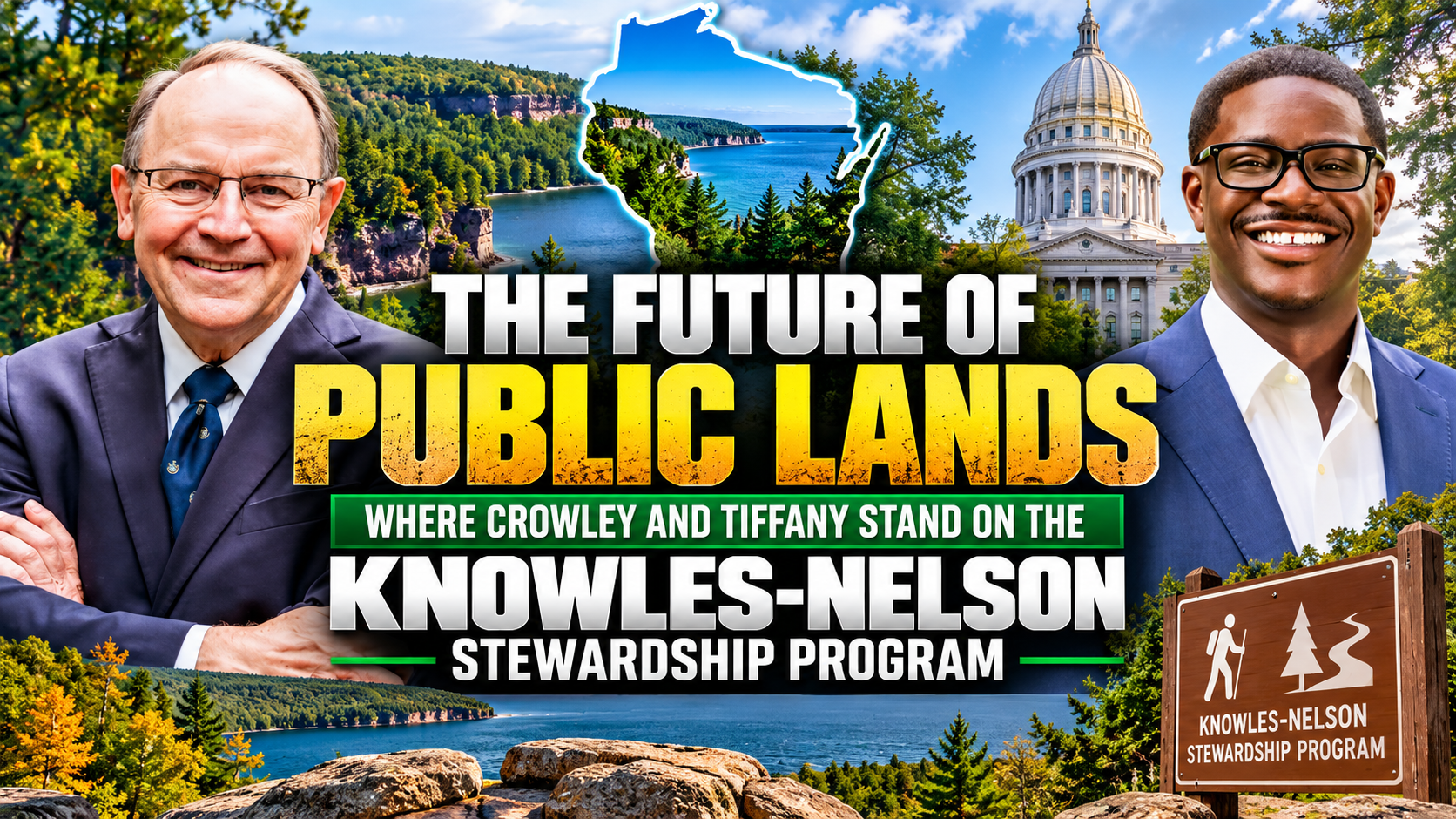
As the campaign season unfolds across Wisconsin, one issue has re-emerged as a major talking point for outdoor enthusiasts, conservationists, and voters alike: the future of the Warren Knowles-Gaylord Nelson Stewardship Program.
First created in 1989 and named after two former Wisconsin governors—one Republican and one Democrat—the Knowles-Nelson program served for nearly four decades as the primary funding mechanism for preserving public lands, protecting water quality, purchasing conservation easements, and improving recreational trails and parks across the state.

With the program’s legislative authorization having lapsed, its revival or replacement has become a defining policy contrast between the major candidates for governor: Democratic Milwaukee County Executive David Crowley and Republican U.S. Representative Tom Tiffany.
Here is an overview of where both candidates stand on land conservation funding and public access to nature in Wisconsin.
David Crowley: Rebuilding and Funding Public Stewardship
Democratic nominee David Crowley has made restoring long-term state funding for land conservation a central pillar of his natural resources platform.
- Reauthorizing Knowles-Nelson: Crowley supports fully restoring state funding for the Knowles-Nelson Stewardship Program, arguing that land acquisition and conservation easements are essential for preserving clean drinking water, expanding public parks, and maintaining Wisconsin’s outdoor recreation industry.
- Local Control & Public Access: Pointing to local projects supported by stewardship grants during his tenure in Milwaukee County, Crowley emphasizes that state matching funds allow municipalities and local land trusts to stretch tax dollars further while opening more green space to urban and rural communities alike.
- Conservation Endorsements: Citing his advocacy for public lands and environmental protections, groups like Wisconsin Conservation Voters have endorsed Crowley, viewing his platform as crucial for bringing back dedicated land preservation funding.
Tom Tiffany: Prioritizing Fiscal Oversight and Property Rights
Republican nominee Tom Tiffany brings a perspective shaped by his background in northern Wisconsin and his service in both the state legislature and the U.S. House of Representatives.
- Fiscal Responsibility and Debt: Tiffany has historically voiced skepticism toward large-scale state land purchases through bonding, arguing that accumulating government-held land removes property from local tax rolls and increases long-term state debt burden.
- Focus on Land Management over Acquisition: Rather than expanding the state’s footprint through new acquisitions, Tiffany emphasizes active management of existing state lands—such as timber harvesting, habitat maintenance, and maintaining public access for hunting and fishing—while advocating for strict fiscal oversight of conservation spending.
- Property Rights and Local Impact: Tiffany places a heavy emphasis on balancing environmental policy with private property rights, arguing that local economic development and agricultural usage should be prioritized alongside public land management.
Key Differences at a Glance
| Policy Focus | David Crowley (D) | Tom Tiffany (R) |
| Knowles-Nelson Funding | Supports full reauthorization and dedicated state funding. | Opposes broad state land purchases using state debt/bonding. |
| Land Strategy | Focuses on acquiring new public spaces, conservation easements, and urban parks. | Prioritizes active management and timber harvesting on existing public lands. |
| Economic Priority | Highlights outdoor recreation, tourism, and environmental protection. | Emphasizes local property tax bases, agriculture, and resource management. |
How to Check Your Voting Status & Learn More
Depending on where you live, local conservation initiatives and state-level candidate races are decided directly by voters at the ballot box. Specific voting rules, polling location updates, and deadlines are set by regional election boards and state election authorities.
To verify your voter registration, review sample ballots, or locate polling options in your area:
- Check your voter status directly on the official state portal at MyVote Wisconsin.
- Consult your local county clerk or election administration office for official guidance on voting logistics.