

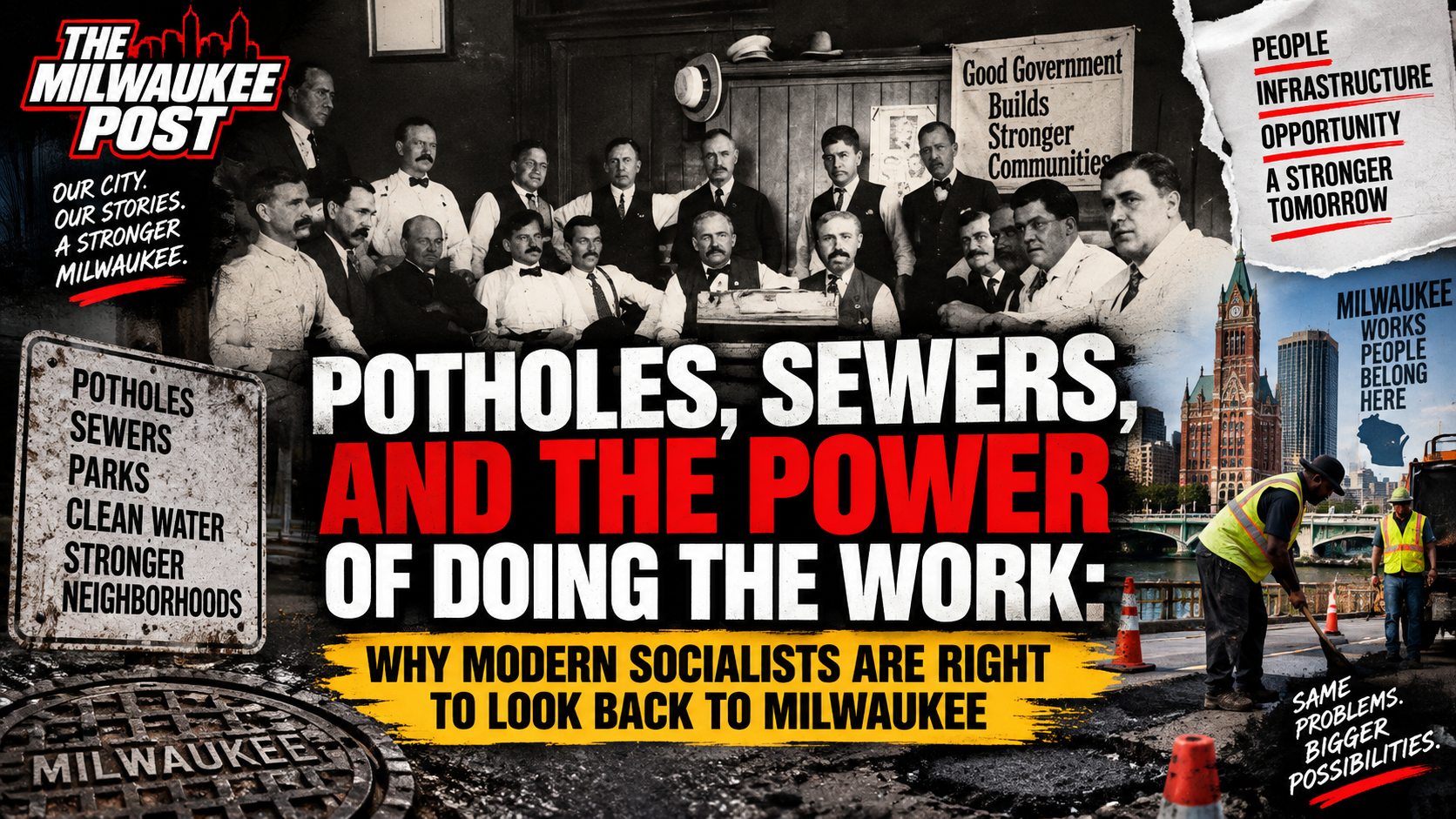
When historians like John Gurda trace the legacy of Milwaukee’s legendary “Sewer Socialists”—figures like Emil Seidel, Daniel Hoan, and Frank Zeidler—they are reflecting on a blueprint that transformed a corrupt industrial town into one of the cleanest, best-run cities in 20th-century America.
So when high-profile modern democratic socialists like New York City Mayor Zohran Mamdani invoke Milwaukee’s history and champion a brand of “pothole politics,” it shouldn’t be dismissed as mere political nostalgia or clever branding. It represents a vital ideological course correction: a shift away from abstract national culture wars and back toward the fundamental business of public delivery.

If the left wants to convince an increasingly cynical public that democratic government can still work, Milwaukee’s “constructive socialism” isn’t just an interesting historical footnote—it remains the definitive playbook.
1. Competence Is the Ultimate Ideological Argument
In the early 1900s, Milwaukee’s early socialist leaders earned the nickname “Sewer Socialists” as a derisive taunt from political rivals who scoffed at their obsessive focus on sanitation, public health, and municipal infrastructure. But the socialists took the moniker and wore it as a badge of honor.
They understood a truth that many modern political theorists forget: You cannot ask people to trust government with big, ambitious ideas if government cannot even handle basic, daily logistics.
By focusing on public utilities, clean water systems, municipal parks, and ending the backroom graft of Tammany-style political machines, Milwaukee’s socialists proved that public ownership and honest governance paid direct dividends to working families. When Mayor Mamdani talks about filling 100,000 potholes or modernizing catch basins to prevent urban flooding, he is channeling that exact ethos. Potholes are not ideological, but fixing them reliably—without turning public goods over to private profiteers—is a deeply political act.
2. Overcoming the “Hope Gap” Through Daily Material Gains
As historical accounts of the era remind us, the ultimate goal of leaders like Victor Berger was never just cleaning up streets; it was giving working-class people a sense of dignity and agency.
Berger famously recognized that the biggest barrier to systemic progress wasn’t a lack of political theory among workers—it was hopelessness. People living in squalor, breathing polluted air, and working 12-hour days didn’t need lofty manifestos; they needed immediate, visible evidence that life could get better.
When a city government paves your street, cleans your park, expands public transit, or builds reliable public housing, it does something profound: it proves that collective action works. Delivering tangible material improvements builds the public trust required to tackle even larger structural challenges down the road.
3. A Prescription for an Era of Polarization
Today’s political landscape is choked with symbolic battles, social media grandstanding, and endless partisan grievance. Voters across the country are exhausted by leaders who talk endlessly about problems while basic public infrastructure crumbles around them.
Reclaiming the Sewer Socialist tradition offers a path forward that transcends hyper-partisan exhaustion. It grounds progressive politics in accountability, fiscal honesty, and concrete deliverables:
- Frugal, graft-free administration that respects public dollars.
- Investment in public goods—from green spaces to municipal transit—that benefit everyone, regardless of income.
- A relentless focus on municipal execution over pure rhetoric.
The Takeaway
John Gurda’s historical perspective reminds us that Milwaukee didn’t thrive despite its socialist mayors—it thrived because of their quiet, unyielding focus on public craftsmanship.
As modern mayors and local leaders look to solve 21st-century urban crises, embracing “pothole politics” isn’t a retreat from big ideas. It is a return to the foundational principle that good governance begins at ground level. If you want to change the world, start by fixing the sewers.