
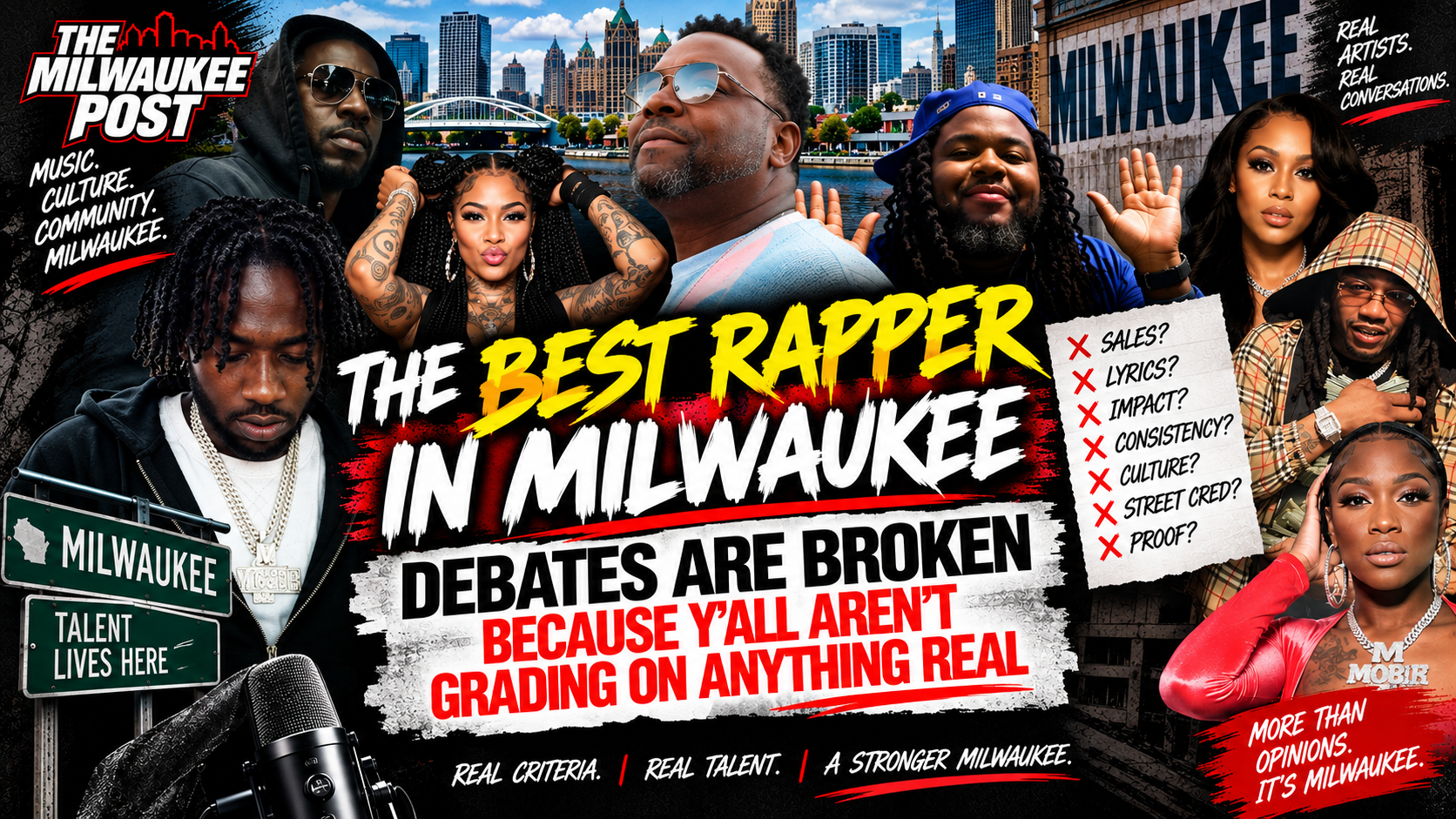
Look around your timeline on any given Sunday. Somebody drops a graphic, a simple text status, or a throwaway tweet: “Who is the best rapper in Milwaukee right now?” or “Who is the top MKE artist in history?”
The comments instantly explode into pure chaos. Everyone throws out their personal favorite—from established powerhouses like Destinee Lynn, to underground heavyweights like Chicken P, AyooLii, or Myaap—and people start arguing in circles until the post dies out.
Milwaukee rapper Destinee Lynn. Source: Radio Milwaukee
It happens every single week. But let’s be completely honest about these debates: They are totally meaningless.
The reason these posts hold zero substance isn’t because Milwaukee lacks talent. It’s because nobody is ever grading the music on actual, verifiable criteria.
The Drake vs. Kendrick Paradox
When the rap world argues over Drake versus Kendrick Lamar, it works because both sides are arguing from a clear, defined standard:
- The Kendrick standard is built on pure artistry, dense lyricism, conceptual projects, and cultural impact.
- The Drake standard is built on commercial dominance, streaming volume, hit-making consistency, and global reach.
Whether you prefer bars or hit records, both positions are grounded in substance you can actually point to.
In Milwaukee, though? That structure disappears. People rank artists based on pure bias, local friendships, or whoever dropped a viral clip yesterday.
Publications like No Bells can curate a critical rundown of the top projects—highlighting project-level artistry like Myaap & Nedarb’s YOP! (#1), Donny Ying’s Get My Bag Right (#2), SuperThrowed Fay Fay’s Baby Driver (#3), Cerop’s From Da Mil to Russia (#4), and Ghost 53206’s FreeBandz Menace (#5). But when the general city talks about who is “the best,” it devolves into a free-for-all because nobody defines what “best” actually means.
The 5 Pillars: How a Real Milwaukee Rap Debate Should Look
If we’re ever going to have a legitimate conversation about who holds the crown in the 414, we need to stop posting cut-and-dry questions and start evaluating artists across five objective pillars:
1. Hard Numbers (Streams & Sales)
- What it measures: Reach, commercial viability, and listener retention.
- Why it matters: Anyone can get a local buzz, but who is converting that buzz into millions of Spotify streams, Apple Music plays, and chart appearances? When a breakout moment happens—like J.P. taking “Bad Bitty” onto the Billboard charts—or when established artists like Destinee Lynn consistently move tens of thousands of streams across every release, those metrics build a factual case that can’t be brushed aside.
Chicken P, widely regarded among MKE heavyweights. Source: Facebook
2. Catalog & Consistency
- What it measures: Longevity, body of work, and project quality.
- Why it matters: Dropping one hot single isn’t enough to make you the best in the city. How deep is your discography? Can you put together a cohesive, front-to-back project?
- Look at veterans like Chicken P (whose Chick James tape sits at #18), Tay Love (The World is Yours, #25), or Big B (Northside Purple Hearted, #24).
- Or look at prolific spitters like Court Loww (2FA2, #10), Big Steff (Talk That Sh* Like Me*, #6), and Mariboy Mula Mar (No Auto Mar 4, #8). Consistency separates one-hit wonders from real leaders.
3. Cultural & Regional Impact
- What it measures: Influence on the city’s signature sound, lingo, and identity.
- Why it matters: Did this artist help invent or push forward a signature Milwaukee style—like low-end slap, off-kilter bounce, or high-energy dance rap?
- Artists like Yonaa (YonaaThon, #9) and AyooLii (This Is Not the Album, This Is for the Fans, #16) capture the raw, unfiltered energy of the local house party and street scene.
- Collaborative duos like SME TAXFREE & RRB Duck (BBL KNOCKERZ, #11) or Deadend Quan & Joe Pablo (Take Notes, #13) showcase the distinct regional shit-talking and tag-team dynamic that defines MKE hip-hop.
4. Technical Skill & Artistry
- What it measures: Pen game, delivery, originality, and vocal control.
- Why it matters: Numbers don’t tell the whole story. Pure rap skill—whether it’s clever punchlines, effortless pocket-riding, distinct vocal delivery, or storytelling—is the backbone of hip-hop culture.
- Consider spitters like Funny $Money (I Got The Hook Up Vol. 1, #15), ÈscoUpp (Mindset Of A Gritter, #19), and Kali Lo (Takin’ Chances 3, #12), who turn vivid street tales into intricate lyrical workouts.
- Look at dynamic vocalists like Lil Sinn (Better Off Alone / Fleeing & Eluding, #7), Dai Ballin (NoAutoDai, #23), or YLFREE (Level 1, #20) who test artistic boundaries with unique flows.
5. Motion & Cultural Equity
- What it measures: National alignment, touring, media coverage, and industry respect.
- Why it matters: Is the national media paying attention? When artists align with major tastemakers—like Myaap touring nationwide with Veeze or pairing up with producer Nedarb, or underground acts like OTB Pablo (#22) and BallySlatt (23Loco, #21) or BigSixx (Get Rich Or Die Trying, #14) drawing national underground ears—it proves the movement carries weight beyond city borders.
Stop Asking “Who Is Best”Start Asking “Based On What?”
Until the city starts holding these debates against actual standards, every “Top 5 in Milwaukee” post is going to remain dry, repetitive, and ultimately useless.
Next time you see someone throw up a status asking who the top artist in the city is, don’t just drop a name. Ask them for their rubric. Are we talking about pure rap ability, streaming power, catalog longevity, or who shifted the culture the most?
Once we start judging artists—from Destinee Lynn to Chicken P, Myaap, and AyooLii—on facts, substance, and real criteria, Milwaukee’s rap conversation will finally get the respect and clarity it deserves.